In high-stake workplaces like operating rooms (ORs), auditory attention is critical. Surgeons and medical staff navigate tasks in a dynamic soundscape of conversations, machine noises, and background sounds. This environment can become a cognitive burden, potentially impacting performance.
To better understand how auditory attention shifts in such settings, researchers designed a study using EEG to measure brain responses to different sound conditions. This research sheds light on how auditory attention operates in real-world, high-pressure environments.

Authors designed the task so it mimics a real-life OR setting. The environment is characterized by multiple sounds containing important information, as well as background noise.
During the experiment, 20 participants played a 3D Tetris-like game. Aside from just playing the game, they had additional auditory tasks + instructions to follow. Let’s look at overview of all sound sources in the study:
- Hospital background noise (irrelevant to the task)
- Two-people conversation (irrelevant to the task)
- Two sounds (irrelevant to the task)
- Occasional instructions for the game
- Alarm sound
- Beep sound
Positioning these sounds in respect to the participant is also an important factor:
 (A) Experiment setup of the Tetris-like game. (B) How different sound sources are placed in the room. Most stimuli have a fixed angle from which they’re played. The only exception is the beep sound, which can happen from any angle.
The exact task is to listen to the occasional instructions from the front, telling where to put the next block. Aside from that, there are two conditions in respect to the Alarm and Beep. The alarm is a long, loud sound coming from the same direction every time. They need to press the space button once the target plays. This condition is called the “narrow condition”.
Then there’s the “wide condition”, in which the participants had a different target – beep sound. It’s short with a low intensity, and is integrated into other stimuli. Thus, the whole soundscape had to be monitored to detect it.
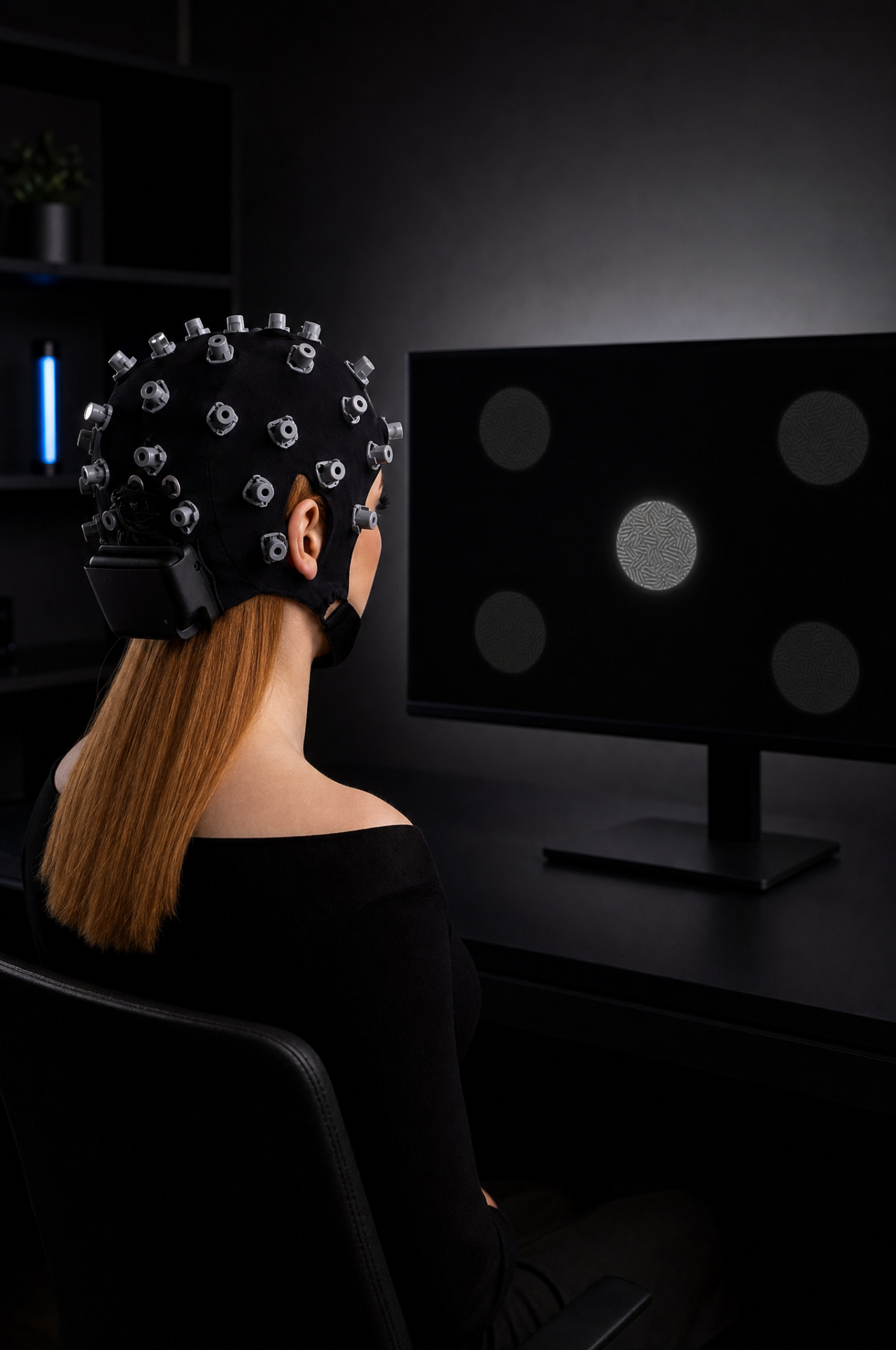
During the task, researchers collected EEG data using mbt’s Smarting system.
To get the subjective feel of the task, participants filled out a workload questionnaire on the NASA-TLX scale. As it consists of different parameters, they are averaged in the study to get one metric.
Analyzing EEG from different angles to investigate auditory attention shifts
Authors extracted Event-Related Potentials – ERPs to compare the brain’s response to the alarm and beep in different conditions. Also, ERPs in response to the task-irrelevant discrete sounds.
Their analysis focused on the frontal N1 and occipital P3 components. N1 component is known to reflect early auditory processing and is modulated by attention. The hypothesis here is that the wide condition will enhance the processing of irrelevant sounds. P3 component marks target detection and attentional engagement. So, researchers can assess how auditory attention is allocated in different conditions for target sounds.
What about the participants’ response to the full soundscape? To find out, authors used Temporal Response Function (TRF) analysis. Unlike ERP analysis, TRF allows to examine how the brain continuously tracks the entire auditory environment. By computing time-locked correlations between EEG and audio, TRFs can reveal specific latency windows (e.g., 100 ms, 200 ms) at which neural responses to sound are strongest.
Within these significant time-windows, they found significant TRF peaks. To do so, the global field power (GFP) of the TRF is derived. The GFP indicates the magnitude of a signal across channels.
Behavioral results
Before we go into what EEG results show, let’s take a look at the behavioral metrics.
 (A) NASA-TLX averaged metric for both narrow and wide conditions. (B) Reaction time of participants for both targets (alarm and beep). (C) Hit rate for each participant in these two conditions. Each black line represents one participant.
The beep, which was expected to be harder to detect, is indeed recognized less frequently than the alarm. This difficulty was also reflected in the higher workload in the wide auditory attention condition (NASA-TLX rating).
The Tetris and speech-instruction performance remained stable across conditions as authors explained in the original paper. This suggests a trade-off between the auditory and visual-motor tasks. The participants seemed to prioritize the Tetris tasks when the auditory task became too demanding.
Both conditions showed increased P3 amplitude for target sound. But there’s no difference in perceiving irrelevant sounds.
 ERPs for (A) Alarm (B) Beep (C) Irrelevant sounds for each condition and averaged over participants and selected channels. The selected channels are marked in white in the topographies. The gray area indicates the average time-window and the topographies show the average amplitudes averaged over this time-window.
Authors analyzed the P3b component of P3 it’s specifically linked to task-relevant stimuli, making it more suitable for examining how attention is allocated to different target sounds (alarm vs. beep) conditions.
We can see a larger P3b response for target stimuli compared to non-targets, confirming that participants actively engaged in the auditory task. Interestingly, despite differences in acoustic properties—the alarm being louder and coming from a fixed direction, while the beep was embedded in background noise and varied in location—both elicited comparable P3b responses. This suggests that even subtle, hard-to-detect stimuli can trigger strong engagement if deemed task-relevant.
Regarding irrelevant sounds, no significant N1 differences were observed between conditions. However, N1 revealed that acoustically salient sounds (alarm and irrelevant noise) produced a strong N1 response, while the less salient beep generated a weaker N1 amplitude. This supports the idea that early auditory responses (N1) are influenced by sound intensity and detectability.
TRF Analysis Reveals Subtle Effects of Soundscape Processing
 (A) Topographies show significant time-windows averaged over time. Also, we can see the TRFs for each channel averaged over participants. In black lines we can see TRF calculated over both conditions (narrow – orange, wide – green). (B) The GFP of the TRF is shown for each condition, averaged over participants. (C) Boxplots show the differences of the individual time-window for each significant time-window.
The study found reliable TRFs for the complex soundscape with three significant time-windows. While previous research has identified these time-windows for speech and music, this is one of the first studies to observe them in a multi-layered soundscape.
Significant increase in neural processing was observed in the wide condition, mainly in the late time-window. It suggests greater engagement with the full soundscape. This aligns with speech-tracking studies, where late-stage processing indicates stronger attention to an attended stream.
But the effect was small, likely because participants didn’t focus much more on the full soundscape in the wide condition. There was also no strong reason to ignore sounds in the narrow condition.
Final thoughts: translation to the OR
This study demonstrates that auditory attention can be studied in a complex soundscape like an OR using EEG. In the results, there are clear neural responses (N1, P3b, and TRFs), showing that even in a dynamic environment, meaningful EEG data can be recorded. Authors note future research should focus on real-world EEG recordings in surgical settings. They could considering factors like long-term exposure, cognitive load, and individual differences in sound perception to better understand when sounds become a burden for medical staff.
For more information and analysis you can find the original paper here (link).
Curious if this setup is right for your study?
Our team works with researchers across neuroscience, sports science and clinical applications - we'll help you figure out if mobile EEG fits your study design.