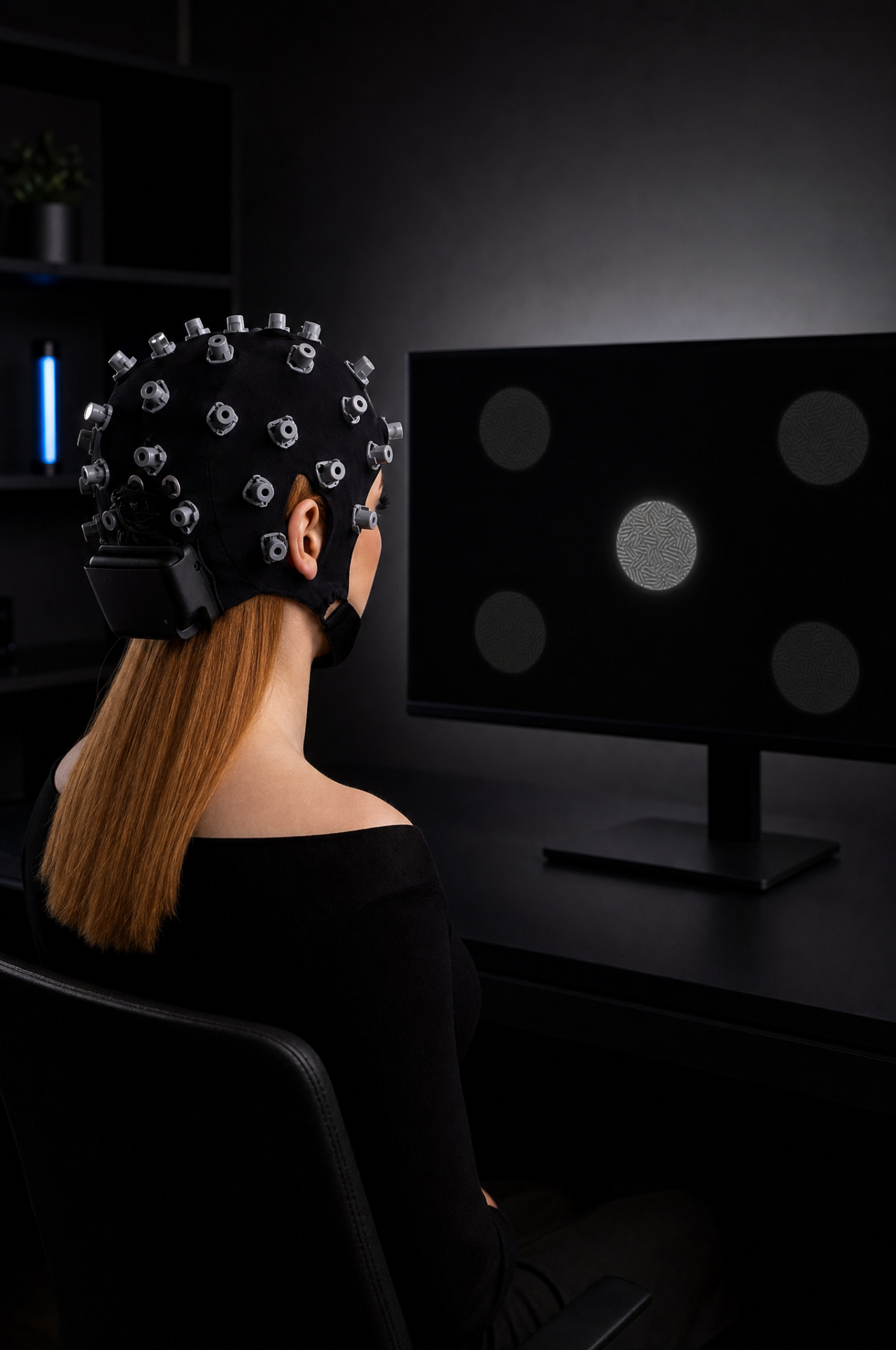
Neuropsychiatric disorders show abnormal cognitive and perceptual processes. This is often linked to disrupted neuroplasticity and imbalances in brain excitation/inhibition.
Current treatments have reached a limit in their effects, which brings the need for different approaches, such as neurorehabilitation. Emerging methods include neurofeedback (NFB) where real-time brain activity is used to improve its function.
A key area of interest in neuropsychiatric disorders is gamma-frequency (30-80 Hz) brain activity. Prior gamma-based neurofeedback systems have shown potential. But, this study aims to take it further with a novel, individualized approach.

46 healthy participants are divided into 2 groups – experimental (28) and control (18). They all came in for 3 sessions, on separate days. For each session, the experimental procedure was repeated 3 times. Let’s take a quick look at the procedure stages:
 Procedure for a one-day session. In total, there were 3 days.
During all these stages, EEG was measured using the Smarting mobile EEG device. For the neurofeedback loop, scientists used PsychoPy and custom scripts. Finally, the communication between two systems was wireless via the LSL protocol.
Stage I is where authors estimated individual gamma frequency – IGF for every participant. How is this done? By using a chirp-based auditory stimulation. This stimuli is actually a periodic chirp, which ranged from 30-60Hz.
Here, we’re expecting an auditory steady-state response – ASSR in the EEG recording. It’s evoked by periodic auditory stimuli in the gamma range, and is commonly used to assess gamma activity in neuropsychiatric studies.
In the image below, we can see more detail on the stimuli and the EEG response to it:
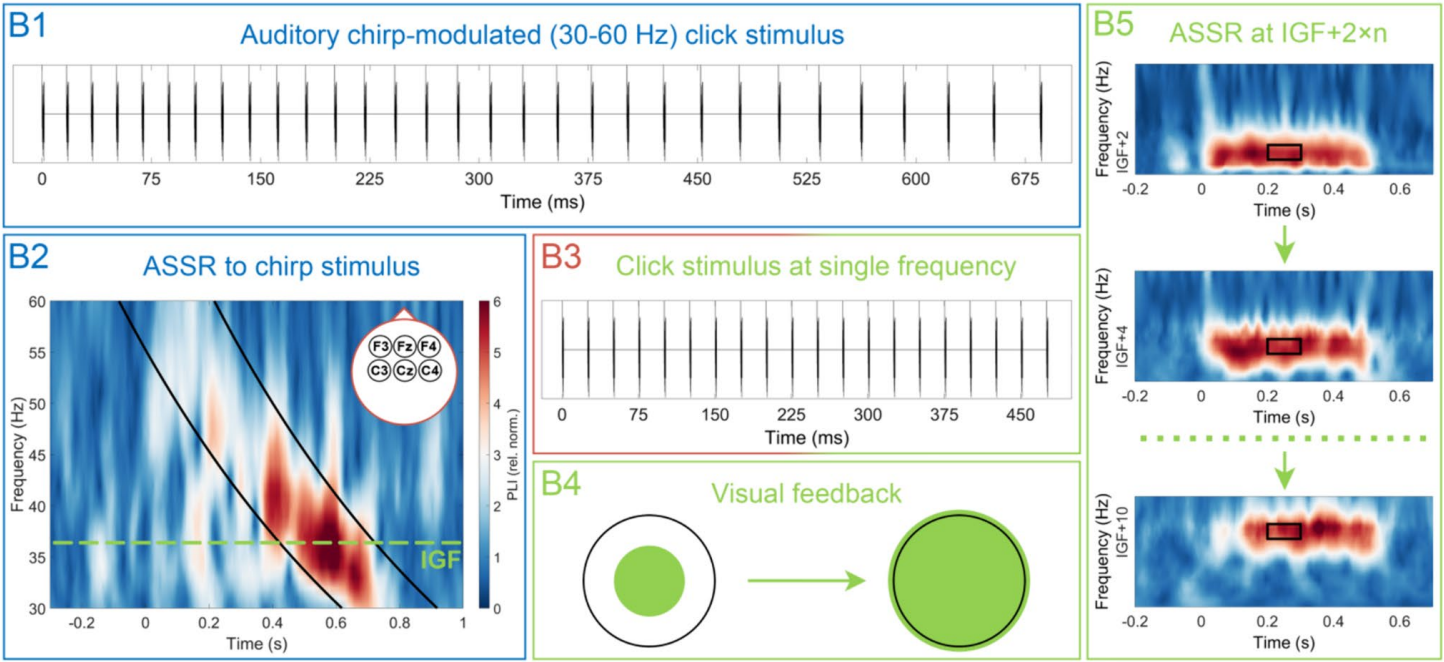 B1+B2: Chirp sound modulated between 30-60Hz and an individual ASSR to such stimulus. We can see a horizontal line where this participant’s IGF is estimated. In the study, they used fronto-central electrodes for IGF calculation. B3: Same auditory stimulus (clicking) but with a constant frequency. B4: during NFB training, participants had to have some kind of feedback. B5: We can see different ASSR for auditory stimulus on different frequencies. Again, see further down for the next procedure stages.
In Stage II, scientists used the estimated IGF to determine the reference response level.
B2 image above shows a mean phase-locking index – PLI value between six electrodes. During IGF estimation, the frequency with highest PLI value was dubbed IGF (seen in dark red here).
In Stage II, participants were presented with a clicking stimulus of constant frequency (B3). This constant frequency equaled IGF. Lastly, the PLI response they showed in this stage is what was defined as reference response level.
This level was neatly illustrated with a black circle in B4 – this is what participants looked at in the next stage.
In Stage III, we move on to the actual neurofeedback training. Again, participants are presented with auditory stimuli, but with gradually changing frequency. If their IGF was ≤ 45Hz the sound would increase from this value, gradually. If IGF was > 45Hz the sound stimuli would decrease from this value. You can see an example of ASSR when stimuli of IGF+2n frequency is played in B5.
How did participants move on to “the next level” of stimuli? They had to focus on the visual stimulus – black + green circle. The green circle represents their response in real-time. It had to be kept the same size as the black outline (reference response level).
The control group didn’t actually look at their response level in real time. They were looking at a playback session of a random individual from the experimental group.
Lastly, Stage IV was the same as Stage I – estimating IGF.
Dividing experimental group into high- and low-responders based on performance
Success rate in keeping the green circle in black outline varied between participants. Here’s the distribution of their mean success rate:
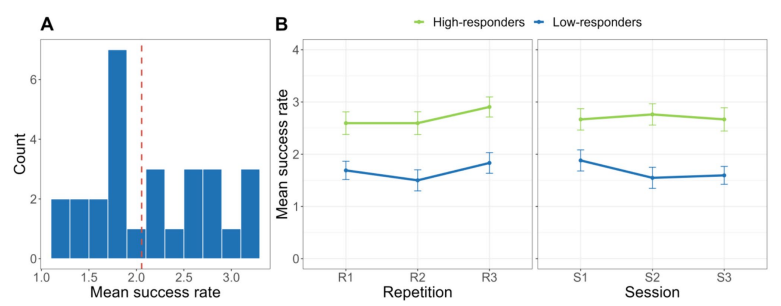 A: Distribution of all participants’ mean success rate. B: High- and low-responders groups and their difference in success rate. On the left, we see the difference in repetitions (averaged across sessions). On the left, we see the difference between sessions (averaged over repetitions per session).
In image above (A) we can see a red, dashed line representing the median. This is the line that separates high- and low-responders groups.
Now, let’s see how all these groups compare in IGF modulation.
The findings suggest that the Neurofeedback system could modulate IGF
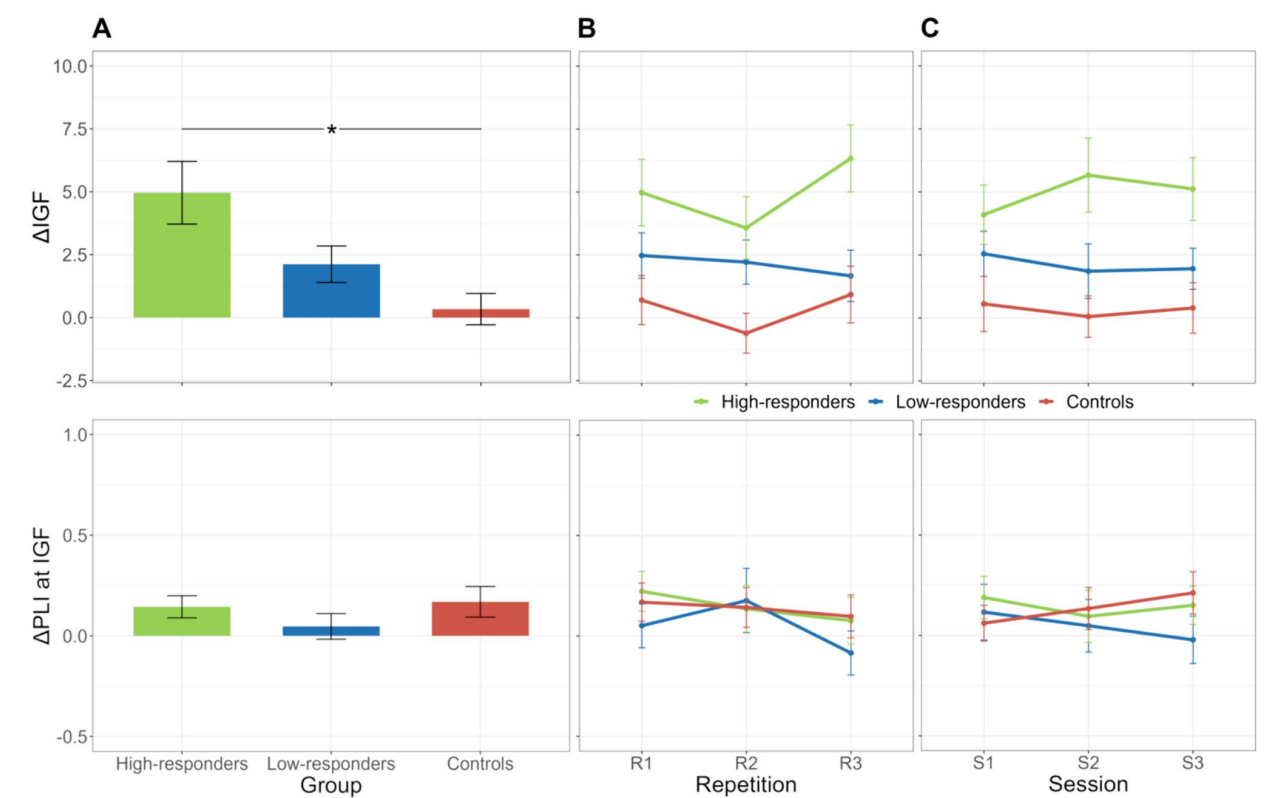 A: Comparing changes in IGF before and after NFB training, between groups (top). Comparing PLI values at IGF for same conditions and groups (bottom). B: ΔIGF and ΔPLI values across repetitions C: and sessions.
The system’s ability to induce immediate changes in IGF aligns with prior research showing variability in NFB performance. But authors didn’t do tests for longer-lasting effects. This was due to alternating IGF-increase and IGF-decrease conditions within the protocol. That could’ve potentially caused participants to oscillate between different conditions.
IGF is a relatively stable brain characteristic, and test-retest reliability showed moderate consistency across sessions. The results are supported by the concept of cortical resilience, where the brain returns to baseline activity after a perturbation. While IGF-based NFB shows promise in modulating neural oscillations, no improvements were observed in working memory performance. This is likely due to the short duration and alternating NFB conditions.
Final thoughts from this Proof-Of-Concept Study
The study highlights the potential of gamma-band sensory stimulation for neuromodulation. It suggests that combining such stimulation with real-time feedback could enhance its effectiveness, which future studies should explore.
The study is linked here, so you can read more about it!
Curious if this setup is right for your study?
Our team works with researchers across neuroscience, sports science and clinical applications - we'll help you figure out if mobile EEG fits your study design.