


The bond between a mother and infant is a complex interplay of emotions and communication that shapes the child’s development. Mother-infant interaction attract scientists who want to understand its impact on cognitive growth.
This hyperscanning research uses mobile EEG technology for new insights into this dynamic interaction. The main focus being on mother-infant interaction during joint attention.
Impact of Mother-Infant Interaction
Mother-infant interaction is a cornerstone of early development. It encompasses a range of communicative cues such as eye contact, facial expressions, and vocalizations.
These cues are essential for establishing joint attention, where both individuals focus on the same object or event.
The shared attention is a vital mechanism for social learning and cognitive development. This has big impact for the infant’s future social interactions and learning abilities.
Mobile EEG: Capturing the Neural dynamics in Real Time
The use of mobile EEG technology has revolutionized the study of mother-infant interaction. Mobile EEG is less intrusive, compared to traditional EEG technology.
This allows capturing the authentic neural responses of both mother and infant during the interaction.
Mobile EEG provides a unique window into the real-time neural dynamics that underlie this complex communication. It offers insights into how shared attention shapes the developing brain.

New Insights from This Research
EEG Procedure
This study involved 37 mother-infant dyads observing flickering images on a screen. The experiment was designed to alternate between two conditions:
-
Joint attention with communicative signals (JA) and
- Joint watching without communicative engagement (JW).
 Mother-infant pairs watched images on a computer screen while their brain activity was recorded with mobile EEG, either interacting (JA) or simply watching (JW).
Image Presentation
Mother-infant dyads participated in a task where they watched images on a computer screen under two conditions (JA, JW). Mothers were either interacting or simply watching with their infants.
The set-up involved alternating between conditions, presenting images of natural objects and everyday scenes, each shown twice per block, with stimuli preceded by an attention-getter and a black screen.
The image Trial structure, used in the study is depicted in the figure Below.
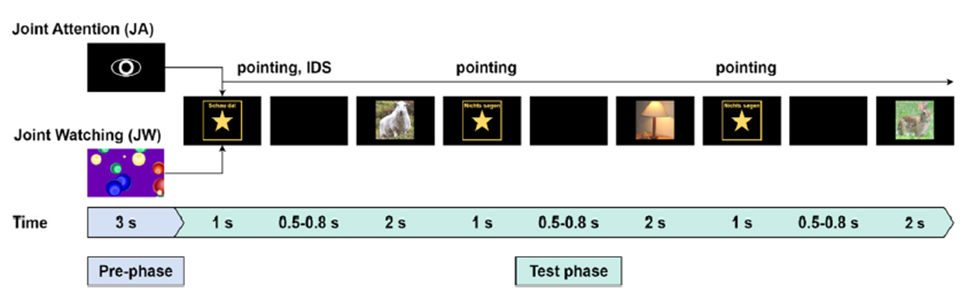 Trial Structure: Each trial included a pre-phase and a test phase, with the pre-phase involving an eye symbol for mother-infant eye contact in JA and colourful bubbles in JW, followed by a test phase with flickering images of animals/objects where mothers in JA were instructed to engage verbally and physically while mothers in JW watched without interaction.
Rhythmic visual stimulation was used to track infants’ and mothers’ attention to flickering images presented on a CRT monitor, with images flickered at 4 Hz and presented at a visual angle on a 19-inch monitor. This way, the scientists elicited the Steady State Visually Evoked Potentials (SSVEP) that were further analysed.
Video recordings were made to code infants’ and mothers’ gaze behaviour, eye contact, and maternal pointing during the EEG assessment.
Study Results
The findings revealed that communicative cues led to a significant increase in neural responses. This was truth in both infants and mothers during the JA condition.
This suggests that these cues are crucial for enhancing attention and object processing. These two parameters are foundational for social learning in infancy.
However, the study revealed that there was no significant increase in neural synchrony during joint attention.
This challenges the notion that communicative cues would enhance the attentional alignment between mother and infant, as measured by neural synchrony.
The unexpected result adds a layer of complexity to our understanding of mother-infant interaction. Thus, requiring further exploration into the subtleties of neural alignment during joint attention.
Implications and Future Directions
The study results demonstrated the EEG technology potential for investigating early cognitive development. It further can help in our understanding on early social development.
The findings can have important implications for early childhood education and parenting. It shows that the communicative cues can have a critical role in engagement and effective learning for infants.
The study paves the way for future research in developmental psychology and neuroscience. It encourages a deeper investigation into the neural basis of early social interactions.
As we continue to examine the neural underpinnings of mother-infant interaction, we can anticipate gaining a more subtle understanding of the mechanisms that shape human social behaviour from the earliest stages of life.
Concluding Thoughts
This study offers an interesting peek into the critical role of communicative cues in mother-infant interaction and their impact on neural responses during joint attention.
While the findings on neural synchrony invite further investigation, the use of mobile EEG provides a promising path for unravelling the complexities of early social interactions.
The full paper can be found on this link: https://www.sciencedirect.com/science/article/pii/S1878929323001263
Curious if this setup is right for your study?
Our team works with researchers across neuroscience, sports science and clinical applications - we'll help you figure out if mobile EEG fits your study design.


