Reactive BCIs decode the brain’s response to external stimuli. They can be fast and accurate, but the decision step is often what holds them back. Most reactive BCI systems use a simple rule: accumulate enough consistent predictions, then act. That works, but it needs careful parameter tuning for each user. It also has no explicit way to balance the cost of waiting against the cost of being wrong.
A study from researchers at ISAE-SUPAERO and Drexel University changes that. They built the first online reactive BCI driven by a partially observable Markov decision process, or POMDP – a principled framework for decisions under uncertainty.
Setting Up the Reactive BCI
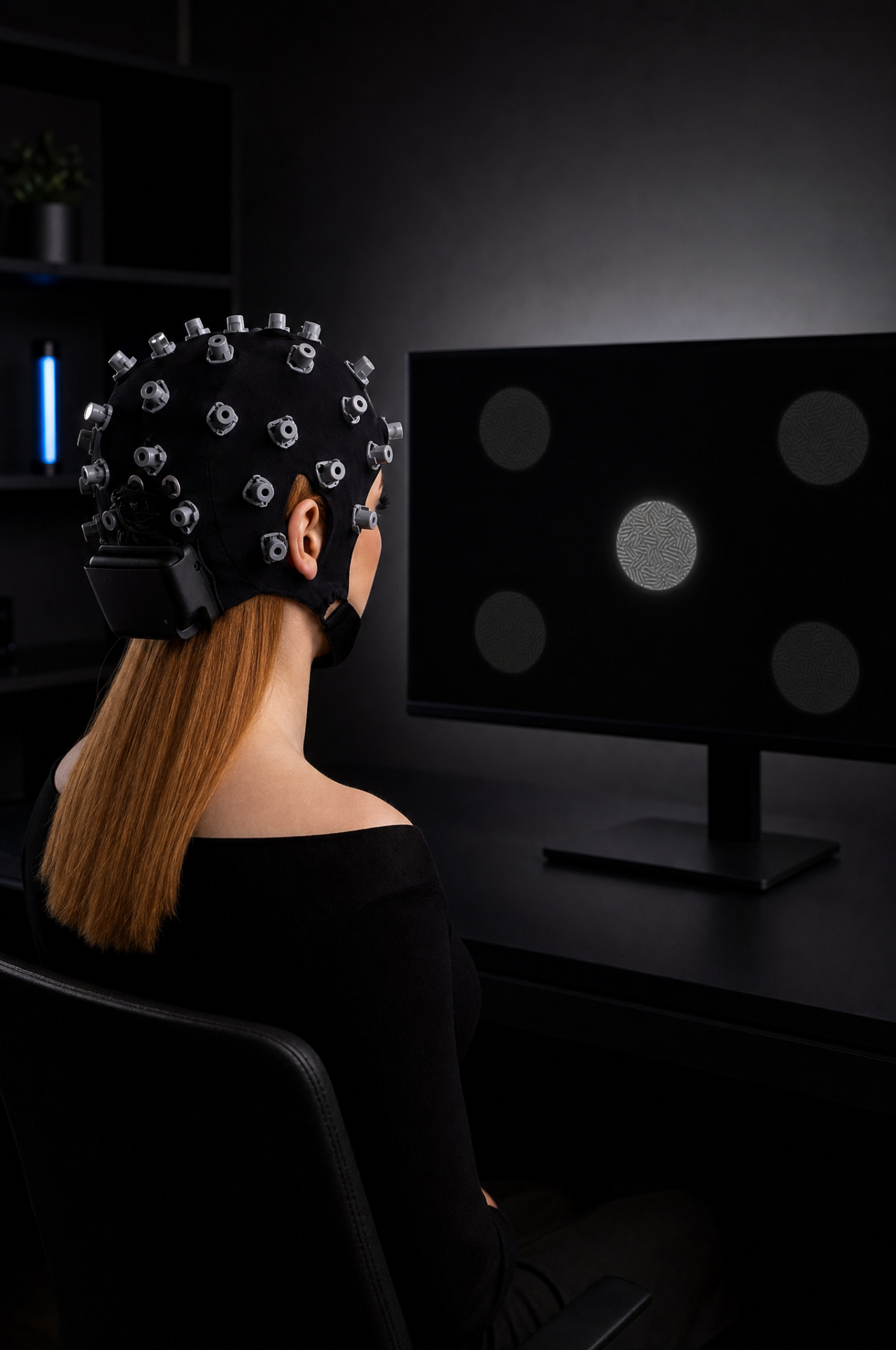
The system works like this: 5 numbered discs are displayed on a screen, and a user selects one by looking at it. Each disc flickers with a unique aperiodic pattern. The brain’s visual response to that specific flicker is what the system decodes. Look at disc 3, and the EEG at occipital sites reflects the code belonging to disc 3. The goal is to identify which target the user is attending to, as quickly and accurately as possible.
The stimulation paradigm the authors use is called “starburst” c-VEP (code-modulated visual evoked potential). Instead of continuous flickers, starburst delivers brief 50 ms bursts with gaps of at least 250 ms between them. Each target is tagged with a unique binary code: flash is “1”, no flash is “0”. So the classifier only needs to learn two stimulus states. This keeps calibration short and independent of how many targets the system has.
The flickers themselves are designed using StAR (Stimuli for Augmented Response). It’s low-contrast, texture-based patches that boost the central-vision VEPs while keeping peripheral distraction low. The result is a display that stays visually comfortable across a full session without losing decoding performance.
Participants completed two sessions of around 20 minutes each.
EEG was recorded with mbt’s Smarting PRO device, focusing on eight channels over parieto-occipital sites (PO7, O1, Oz, O2, PO8, PO3, POz, PO4). That sparse array was enough to decode five targets reliably in real time.
A Task Design That Hides Its Own Calibration
Each session ran through 4 phases:
- A calibration task. Each target was cued in sequence while the system collected labelled brain data to train the classifier.
- A validation task. Participants could activate any target freely to check the system felt responsive. They could request recalibration if not.
- A cued task. Targets were again cued in sequence, now with visual feedback. A correct prediction turned the target green. An incorrect one turned it red.
- A self-paced Pinpad task. Participants had to activate a 4-digit code in order, at their own pace, with no external cuing.
The two sessions shared the same structure. The only difference was the decision agent on the Pinpad task. In the Control session, both cued and Pinpad tasks used standard accumulation. In the Experimental session, the Pinpad task ran under POMDP control.
To operate, the POMDP needs calibration data to build its observation model, the classifier’s confusion matrix. Rather than adding a passive calibration block, the researchers embedded this step inside the existing cued task. Users experienced it as normal reactive BCI operation with visual feedback. After the cued task, the POMDP policy was computed in under two minutes. Then the Pinpad task began.
 The sequence diagram lays out the full experimental flow. Each phase feeds the next: calibration trains the classifier, the cued task fills the POMDP observation model, and only then does the self-paced Pinpad begin. This makes calibration seamless rather than a separate burden on the user.
What a POMDP Does in a Reactive BCI
With standard accumulation, the classifier runs continuously, outputting a target prediction on each cycle. The system waits until the same target has been predicted a fixed number of times in a row, then selects it. It’s a simple rule, but it’s the same rule for every user, regardless of how clean or noisy their signal is. The POMDP takes a different approach.
At each time step, the model holds a probability distribution over which target the user is gazing at. Each new classifier prediction updates this distribution via Bayes’ rule. The policy is computed offline before the reactive BCI session starts. It maps distribution states to one of two actions: wait and collect another observation, or commit to a target now.
The cost structure is explicit. Waiting incurs a small-time penalty, and selecting the wrong target incurs a large error penalty. So the model preferred to wait rather than guess.
This is the key difference from accumulation in a reactive BCI context. The system doesn’t just count consistent predictions, it reasons about accumulated uncertainty and the cost of being wrong.
 The pipeline overview shows the full signal path. EEG windows are fed into the classifier (left). Predictions populate an N×N confusion matrix (center). That matrix becomes the POMDP observation model. The model uses it to update the distribution and decide when to act (right). The confusion matrix is the link between decoding and decision, built from each participant’s own calibration data.
The Results: Faster Without Being Riskier
Across all tasks and conditions, accuracy stayed high. Both the accumulation strategy and the POMDP kept group accuracy above 97%. The POMDP didn’t compromise accuracy.
The difference showed up in timing. In the self-paced Pinpad task, the POMDP reduced mean decoding time to around 1.55 seconds. The accumulation baseline took nearly 1.97 seconds. That’s a reduction of more than 20%. This difference was specific to the task where the POMDP was active. The cued tasks showed no meaningful timing difference between sessions.
 The results plot makes this visible. Decoding time in the Experimental Pinpad condition sits clearly lower than the other three. Accuracy is flat across all of them. The speed gain lands exactly where the POMDP was in control, with no cost elsewhere.
The time reduction came from acting early when evidence converged quickly. Accumulation needs a minimum data window plus a streak of consistent predictions before committing. The POMDP can commit the moment its distribution is confident enough. For participants with clean brain responses, that means deciding before accumulation would allow it.
The POMDP also had a fail-safe. If uncertainty stayed too high at the end of a trial, the model could restart rather than force a low-confidence selection. In practice, this never triggered for any participant. The starburst c-VEP paradigm consistently produced enough evidence to decide within a single trial.
One Parameter Instead of Many
The accumulation strategy needed three hand-tuned parameters. First, a minimum data window. Second, a minimum streak of consistent predictions. Third, a maximum trial duration. These are fixed at the system level and do not adapt between users.
The POMDP replaces all of this with one design-level choice: how heavily to penalize incorrect decisions. Everything else (when to commit, how long to wait) follows from the user’s own observation model. Cleaner brain responses lead to faster decisions. Noisier responses lead to more cautious ones.
This also makes the framework broadly applicable. The same POMDP structure has been validated offline across multiple reactive BCI paradigms, including SSVEP and P300. This online study is the first proof that it works in real time.
This study is the first online demonstration of a POMDP-based decision framework for a reactive BCI. It delivers faster decisions without sacrificing accuracy. It also replaces multiple hand-tuned thresholds with a single, principled parameter. Future work will focus on reducing calibration burden further, potentially by pairing POMDP control with calibration-free decoding. And on approaches that update the observation model live during reactive BCI operation.
Read the original paper: Torre Tresols et al. (2026)
Curious if this setup is right for your study?
Our team works with researchers across neuroscience, sports science and clinical applications - we'll help you figure out if mobile EEG fits your study design.